Maria Island
Maria Island
A national park island in Tasmania listed as UNESCO World Heritage, Maria Island combines penitentiary heritage, geological cliffs and reintroduced endemic wildlife, accessible by ferry from Triabunna.
Off the east coast of Tasmania, Maria Island combines UNESCO-listed penitentiary heritage, remarkable geological formations and reintroduced endemic wildlife. Accessible only by ferry from Triabunna, the island prohibits vehicles, making it a favoured destination for hiking and cycling among Tasmania's visitors.
Why visit Maria Island
Maria Island brings together three assets rarely combined on a single island. First, a major historical site: the village of Darlington, a former colonial penitentiary centre, is inscribed on the UNESCO World Heritage list. Next, distinctive geological formations: the Painted Cliffs and their sandstone patterns, the Fossil Cliffs and their fossilised marine sediments. Finally, visible and accessible wildlife: wombats, forest kangaroos, Bennett's wallabies and Tasmanian devils roam freely, often just metres from the trails.
The complete absence of vehicle traffic reinforces the peaceful character of the place. Travel is on foot or by bike, within a protected environment designated as a national park since 1971.
History and heritage
The island was called Toarra-Marra-Monah by Tasmania's Aboriginal people. It was named Maria Island in 1642 by Dutch explorer Abel Tasman, in tribute to Maria van Aelst, wife of the Governor-General of the Dutch East Indies at the time.
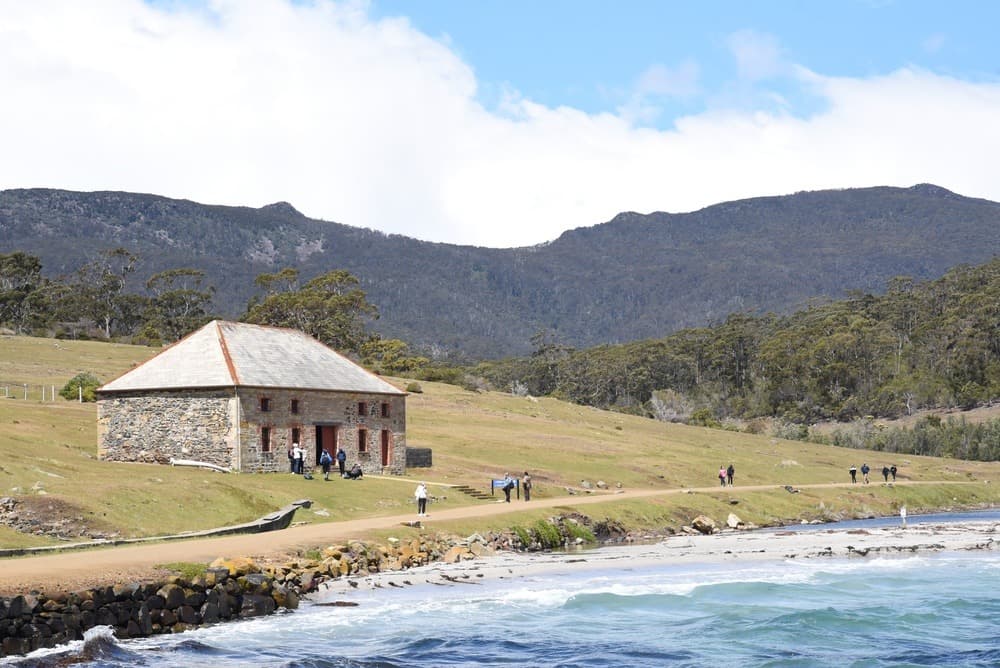
In the nineteenth century, the island became an experimental penitentiary centre for British convicts transported to Australie. The village of Darlington preserves the remains of this period: buildings dating from 1824, ruins of the commissariat and colonial warehouses. This ensemble is listed on the UNESCO World Heritage list as one of Australie's convict sites.
Maria Island became a national park in 1971, which enabled the gradual restoration of the buildings and the implementation of wildlife conservation programmes.
What to see on the island
Darlington and its UNESCO heritage
The hamlet of Darlington is the entry point and historical heart of the island. The Coffee Palace Museum traces the penitentiary and colonial history of the site. The restored former buildings, commissariat and warehouses can be explored independently via an interpretation trail.
Painted Cliffs and Fossil Cliffs
The Painted Cliffs, to the south, feature golden sandstone patterns shaped by erosion, particularly visible at low tide. The Fossil Cliffs, to the north, expose marine fossils in a sedimentary cliff dating from the Permian period, several hundred million years ago. Both sites are accessible within a few hours' walk from Darlington.
Fauna and birdlife
The island is home to wombats, forest kangaroos and Bennett's wallabies. Tasmanian devils have been reintroduced as part of a conservation programme aimed at preserving the species from a tumour disease that is decimating mainland populations. Recognised by BirdLife International as an Important Bird Area (IBA), Maria Island welcomes notably the Critically Endangered Forty-spotted Pardalote, the Tasmanian Pardalote and the Pacific Gull.
Main hiking trails
- Bishop & Clerk: 4 to 5 hours return, an ascent offering views over the Freycinet Peninsula.
- Mount Maria: approximately 8 hours return, the island's highest peak.
- Painted Cliffs and Fossil Cliffs: short walks accessible in half a day.
When to go
Maria Island's climate remains mild year-round, with an annual average near 16 °C. The period from January to April offers the most favourable conditions for hiking and swimming. Australian spring (October-December) is interesting for observing wildlife and nesting birds. Winter, cooler and windier, provides access to quiet trails but can complicate exposed ascents such as Mount Maria.
How to get there
Access is exclusively by ferry from Triabunna, located approximately 1 hour 15 minutes' drive from Hobart. The crossing takes 45 minutes and offers a view of Tasmania's east coast.
- Several departures daily year-round, with increased rotations in high season (December-February).
- Boarding at Maria Island Gateway, near Triabunna's wharf.
- Arrival at Darlington, the starting point for the trails.
- Check-in recommended in advance, times to be verified with the operator.
Practical information
No vehicles are permitted on the island. Travel is on foot or by bike (rentals available in Triabunna before boarding).
Accommodation: former colonial buildings converted into rustic lodgings at Darlington, and camping areas. Booking is essential in season.
Supplies: no shops on the island. Water, food and equipment must be brought from Triabunna.
Guided multi-day hikes: recognised operators such as Maria Island Walk and Life's an Adventure offer circuits with accommodation and logistics included.
Entry fees: a Tasmania Parks Pass is required (fees to be checked with Parks & Wildlife Service Tasmania).
Nearby attractions
Tasmania is full of natural sites to complement a visit to Maria Island:
- Honeymoon Bay, in the neighbouring Freycinet Peninsula, for its turquoise waters.
- Devils @ Cradle, a sanctuary dedicated to observing Tasmanian devils near Cradle Mountain.
- Cataract Gorge, an urban gorge in Launceston, accessible from northern Tasmania.
- Gordon River, on the wild west coast, for cruises through temperate forest.
Frequently asked questions
Frequently asked questions
A day visit allows you to see Darlington and one of the two cliff sites (Painted Cliffs or Fossil Cliffs). To combine high-altitude hiking and heritage exploration, allow 2 to 3 days with one night on the island.
Yes, Tasmanian devils have been reintroduced to Maria Island as part of a conservation programme. However, sightings remain difficult as the species is nocturnal and elusive.
Booking is strongly recommended, particularly from December to April when rotations fill up quickly. Outside the season, on-site purchase is still possible but not guaranteed.
Yes: former colonial buildings have been converted into rustic lodgings at Darlington, and several camping areas are available. No luxury options: you need to be prepared for a certain level of self-sufficiency.
Yes, the island is family-friendly thanks to short trails (Painted Cliffs, Fossil Cliffs), the absence of traffic and easily visible wildlife. Ascents of Mount Maria and Bishop & Clerk are best suited to experienced hikers.
Including Maria Island in your trip
Maria Island fits naturally into a circuit along Tasmania's east coast, between Hobart, the Freycinet Peninsula and the Bay of Fires. To build a complete itinerary through Australie that includes Tasmania, consult our bespoke trips to Australie.
Interested in this visit?
We can include it in your personalised itinerary.