Adventure Bay on Bruny Island
Adventure Bay on Bruny Island
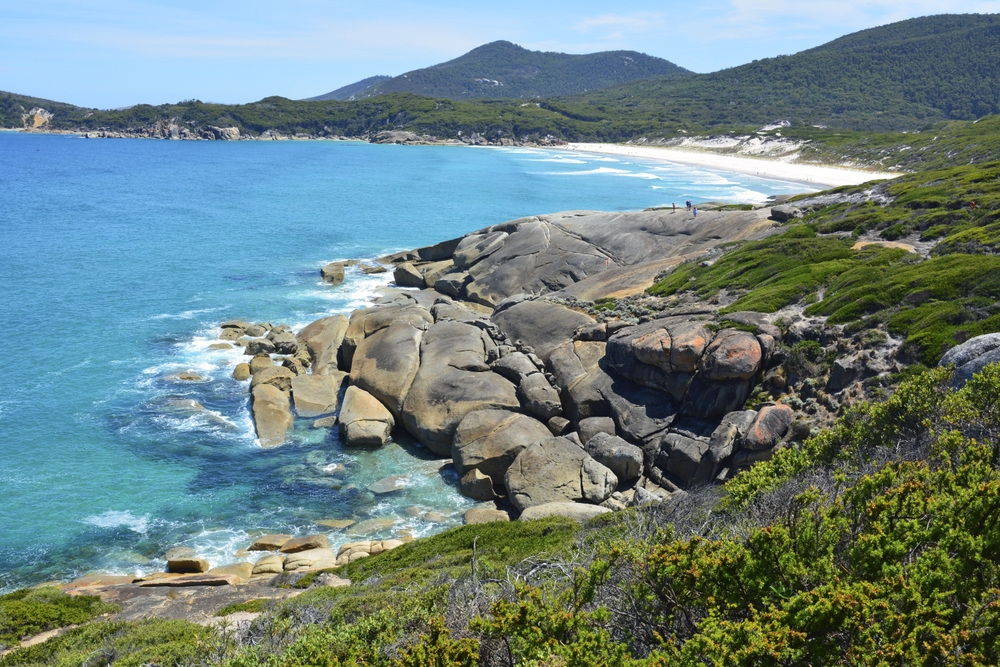
Adventure Bay, on Bruny Island south of Hobart, combines sheltered beach, temperate rainforest trails, Pacific exploration museum and southern right whale watching.
In south-eastern Tasmania, in the D'Entrecasteaux Channel, Adventure Bay borders the east coast of South Bruny Island. The bay combines sheltered beach, temperate rainforest trails, historic sites linked to major Pacific expeditions, and southern right whale watching in season. A day trip from Hobart is entirely possible, but spending a night on the island allows you to make the most of the hiking and local museum.
Why visit Adventure Bay
Adventure Bay brings together three centres of interest rarely combined in Tasmania: a pristine coastline suited to walking and swimming, a maritime heritage documented by a specialist museum, and marine wildlife observable from the shore. The trails cross a temperate rainforest typical of Bruny Island, with eucalyptus, tree ferns and damp clearings. The bay itself remains calm, sheltered from prevailing winds, making it a family-friendly stopping point.
The site also has notable historical interest: it was one of Tasmania's first European anchorage points, visited in turn by Dutch, British and French navigators from the 17th to 18th centuries.
A bay at the heart of major Pacific expeditions
Bruny Island was first sighted by Dutch navigator Abel Tasman in 1642. Tasman attempted to anchor his ship Heemskerck at Adventure Bay, but a severe storm prevented him from approaching: he then named the area Storm Bay, a name that today designates the larger open bay further north.
In 1773, the HMS Adventure dropped anchor in the bay and gave it its current name. The ship was commanded by Captain Tobias Furneaux, a Royal Navy officer who had just parted from HMS Resolution under Captain James Cook during the latter's second voyage in the Pacific. The bay subsequently became a regular stopover for European expeditions, including that of French Admiral Joseph-Antoine Bruny d'Entrecasteaux, who gave his name to the island and the neighbouring channel.
In the 19th century, Adventure Bay also served as a base for the whaling industry. Archaeological excavations have revealed on the shoreline traces of ancient whaling camps and associated structures, now integrated into the landscape.
What to do at Adventure Bay
Adventure Bay Road and East Cove
The Adventure Bay Road runs along the coast to East Cove, at the north-eastern tip of South Bruny. At the end of the road, a car park serves a flat coastal track leading to Grassy Point. The walk remains accessible to families and offers continuous views over the bay. This is also where most whale observations from shore take place.
Mavista Nature Walk
From Adventure Bay Road, the turnoff Lockleys Road then Resolution Road lead to the marked trail of Mavista Nature Walk. The short, shaded route crosses a temperate rainforest and a tree fern clearing beside a small stream. Interpretive panels present the ecosystem of Bruny Island's forest. Bring sturdy footwear, as the ground often remains damp.
Mount Mangana
The Coolangatta Road leads to Mount Mangana, the highest point of South Bruny, from where you can take in the bay and surrounding forests. The access track requires a suitable vehicle in wet weather.
Fluted Cap Trail
For more experienced walkers, the Fluted Cap trail starts from the East Cove car park or Grassy Point. The hike is long and strenuous, with uphill sections, but it offers sweeping coastal views over the dolerite cliffs characteristic of Tasmania. Allow half a day return.
Bligh Museum of Pacific Exploration
The Bligh Museum of Pacific Exploration occupies a small building whose bricks are said to have been made by convicts in the 19th century. The collection brings together maps, historical documents and paintings devoted to the captains who passed through the island: William Bligh, James Cook, Tobias Furneaux and Admiral Joseph-Antoine Bruny d'Entrecasteaux. The museum also displays works attributed to John Webber and William Hodges, official painters of the Cook expeditions. The foundation stone was laid on 9 September 1955, on the occasion of the 200th anniversary of Captain William Bligh's birth.
Practical information
- Allow a minimum of half a day on site, a full day if you combine museum and hiking.
- No large supermarkets on South Bruny: plan for fuel, water and provisions before crossing.
- Partial mobile coverage on the island, negligible on the trails.
- Warm clothing advised even in summer, southern winds cool the bay quickly.
When to visit Adventure Bay
Bruny Island, like all of Tasmania, experiences cool weather for much of the year. The mildest period extends from December to March (Australian summer), with mild temperatures and long days, ideal for hiking and swimming. Southern right whales pass offshore between May and October, with peak sightings in winter and early Australian spring. Autumn (March-May) remains pleasant for forest walks. On sunny days, a hat and sunscreen are recommended: UV levels are high in Tasmania.
How to get to Adventure Bay
Adventure Bay is about two hours' drive from Hobart, ferry included. From Hobart, allow about 40 minutes' drive south to Kettering, the departure point for the vehicle ferry. The crossing to Roberts Point, Bruny Island's main terminal, takes about twenty minutes. From Roberts Point, it's another 35 minutes or so by road through South Bruny to reach Adventure Bay. The ferry runs several times daily; in high season, queues can be long, so arrive early.
What to combine in the region
Adventure Bay integrates well into a Tasmania itinerary from Hobart:
- Cape Raoul, on the Tasman Peninsula, for its spectacular dolerite cliffs.
- Cradle Mountain National Park, further north-west, for high mountain hiking.
- Hobart, an ideal logistical base, with its MONA museum and Salamanca market.
Frequently asked questions
Frequently asked questions
Yes. Leaving early from Hobart, a day is enough to combine ferry, coastal walk to East Cove and a visit to the Bligh Museum. To add a hike like Fluted Cap, it's better to plan a night on the island.
Booking is generally not mandatory but is recommended in high season (Australian summer, school holidays) to avoid long queues at Kettering.
Southern right whales pass offshore between May and October during their migration. Several points along the Adventure Bay coast allow you to spot them from the mainland.
Yes, it's a long hike with elevation gain, best reserved for experienced walkers. Allow half a day return, with sturdy shoes and plenty of water.
A few cottages, B&Bs and campsites are available at Adventure Bay and in the immediate surroundings. Offerings are limited, so book ahead in summer.
Plan your trip
Bruny Island and Adventure Bay fit naturally into a Tasmania itinerary from Hobart. To build a stay that combines wild coastlines, national parks and colonial heritage, consult our tailor-made trips to Australie.

Interested in this visit?
We can include it in your personalised itinerary.