Atherton Tablelands
Atherton Tablelands
A volcanic plateau west of Cairns, the Atherton Tablelands combine rainforest, crater lakes, waterfalls and endemic fauna from northern Queensland.
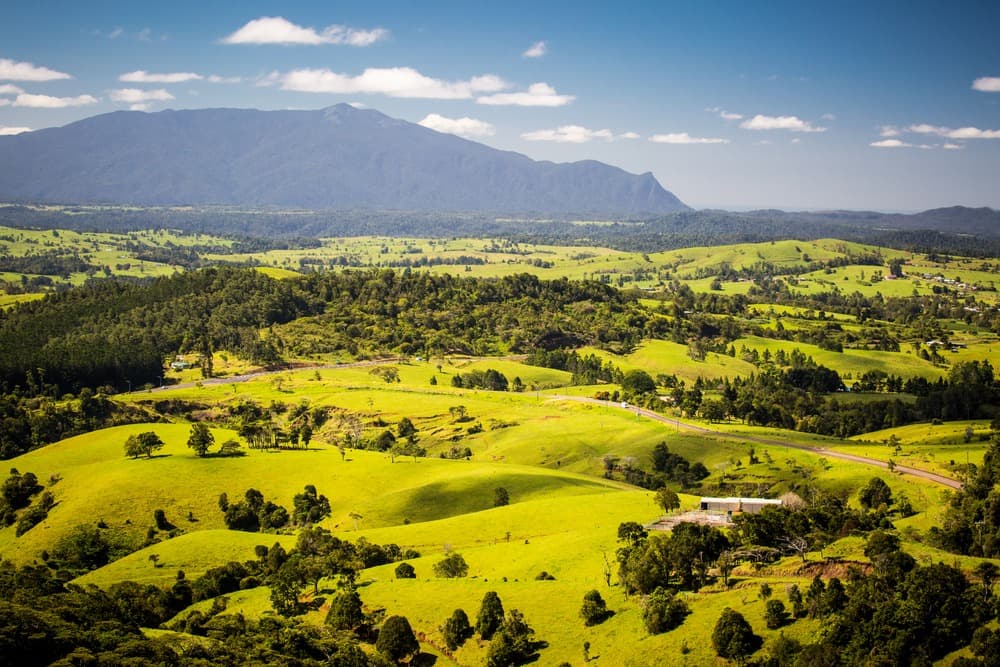
The Atherton Tablelands form a volcanic plateau located west of Cairns, in northern Queensland. This high-altitude region, between 500 and 1,100 m, combines World Heritage–listed humid rainforests, crater lakes, waterfalls and farmland. It provides a cool alternative to the coast and ideal terrain for hiking, mountain biking and wildlife observation.
Why visit the Atherton Tablelands
The plateau brings together several landscapes within a confined area: ancient Wet Tropics rainforest, volcanic lakes with crystal-clear waters, waterfalls fed by monsoon rains, coffee and tropical fruit plantations. The relative coolness from altitude makes the region pleasant even during warm seasons. The Tablelands are home to endemic wildlife rarely seen elsewhere, including Lumholtz's tree-kangaroo and over 300 bird species.
History
The region has a long Indigenous history. The highlands sheltered more than a dozen Aboriginal groups, whose livelihoods centred on fishing, foraging and hunting in the rainforest.
European arrival dates to the second half of the 19th century. James Mulligan was the first European explorer to lead an expedition there in 1875. John Atherton, who gave his name to one of the main towns, travelled there in 1877 to study gold and tin mines. Settlers subsequently developed red cedar extraction, before cleared land was converted into agricultural and grazing zones—which remain economic drivers alongside tourism today.
Another contribution is often overlooked: it was the Chinese who introduced agriculture to the Atherton plateaus. Established in the Palmer River goldfields to the north, they created vegetable gardens, then participated in dairy production and local supply. The Hou Wang temple and museum, in the town of Atherton, traces this active presence from the late 19th to early 20th century.
What to see and do
Rainforest and hiking trails
The Crater Lakes National Park and the Misty Mountains, in Wooroonooran National Park, offer a network of trails of varying lengths through humid forest. Several secondary waterfalls reveal themselves along the way.
Mountain biking
Two sites structure mountain biking in the area:
- The Atherton Forest MTB Park, with roughly 60 km of marked trails for all levels.
- The Davies Creek MTB Park, more technical, with winding tracks through the Lamb Range mountains.
Equipment rental is available in Atherton or Cairns.
Waterfalls
Near the town of Ravenshoe, Millstream Falls are reputed to be Australia's widest waterfall. Nearby, Tully Falls drop around 300 m into the Tully Gorges, with flow that depends heavily on the wet season. Other smaller falls punctuate the Misty Mountains trails.
Lakes
- Lake Eacham: swimming in a volcanic crater surrounded by forest.
- Lake Tinaroo: an expansive water body suited to swimming and water activities.
- Lake Barrine: kayaking and walking tours around shaded shores.
Wildlife
The Tablelands are a refuge for platypuses, multicoloured frogs and Lumholtz's tree-kangaroo, a species endemic to northern Queensland. For birds, over 300 species frequent the area, including the Royal Parrot, Crimson Rosella and Barking Owl.
Some 25 km north-west of Cairns, the village of Kuranda, nicknamed the "Village in the Rainforest", is home to Koala Gardens and a butterfly sanctuary.
Local produce
The plateau hosts Australia's oldest coffee plantation, dairy farms, tropical fruit producers and distilleries. Yungaburra markets, held regularly, provide an excellent entry point to taste these local products.
When to visit
With altitude between 500 and 1,100 m, the plateau enjoys a tropical climate cooler than the coast. The dry season, roughly May to October, offers the most stable conditions and corresponds with peak tourist season. The wet season, December to April, brings heat and significant rainfall: waterfalls are then at full flow, but some trails may be waterlogged or closed.
How to get there
Cairns is the most practical departure point. Two main roads serve the Tablelands from the coast:
- The Gillies Highway, to the south, leads directly to Lake Barrine and Lake Eacham.
- The Kuranda Highway reaches the heights via Mareeba, Tolga, Atherton and Lake Tinaroo.
A rental vehicle is recommended to connect the various sites, as distances between attractions are significant.
Practical information
- Allow a minimum of two to three days to combine forest, lakes and waterfalls; a week for in-depth exploration.
- Temperatures can drop noticeably in altitude in the evening: bring a fleece, even in summer.
- Insect repellent and hiking shoes are essential on humid forest trails.
- Mobile coverage can be limited in national parks: download offline maps.
Nearby
The Atherton Tablelands naturally extend to other sites in northern Queensland and fit into a broader Australian itinerary. To deepen Indigenous culture understanding, the Injalak Arts and Crafts Centre in the Northern Territory is a relevant complement. Travellers seeking other national parks can extend the experience to Cradle Mountain National Park in Tasmania. For museums, the Australian Museum in Sydney offers broader perspective on Australian fauna and natural history.
Frequently asked questions
Frequently asked questions
Two to three days permit an overview of the main lakes and waterfalls. A week is more comfortable for combining hiking, mountain biking, wildlife observation and local markets.
Yes, a personal vehicle is highly recommended. Attractions are dispersed across a wide plateau and public transport remains limited outside the Cairns–Kuranda link.
Waterfalls display maximum flow during and just after the wet season (December to April). In the dry season, they remain visible but less powerful; trails are more passable.
Yes. Lake Eacham and Lake Tinaroo are suited to swimming. Lake Barrine is better suited to kayaking and walks around its forested shores.
Yes. Many short trails, the butterfly sanctuary and Kuranda's Koala Gardens, as well as lake swimming, are well suited to children.
Plan your trip
The Atherton Tablelands fit naturally into an itinerary between Cairns, the Great Barrier Reef and the bush of northern Queensland. To build a bespoke journey including this region, explore our circuits in Australie.
Interested in this visit?
We can include it in your personalised itinerary.