Russell Falls
Russell Falls
In the heart of Tasmania, within Mount Field National Park, Russell Falls offers a first glimpse into the Australian wilderness. Among the towering trunks of temperate rainforest, the
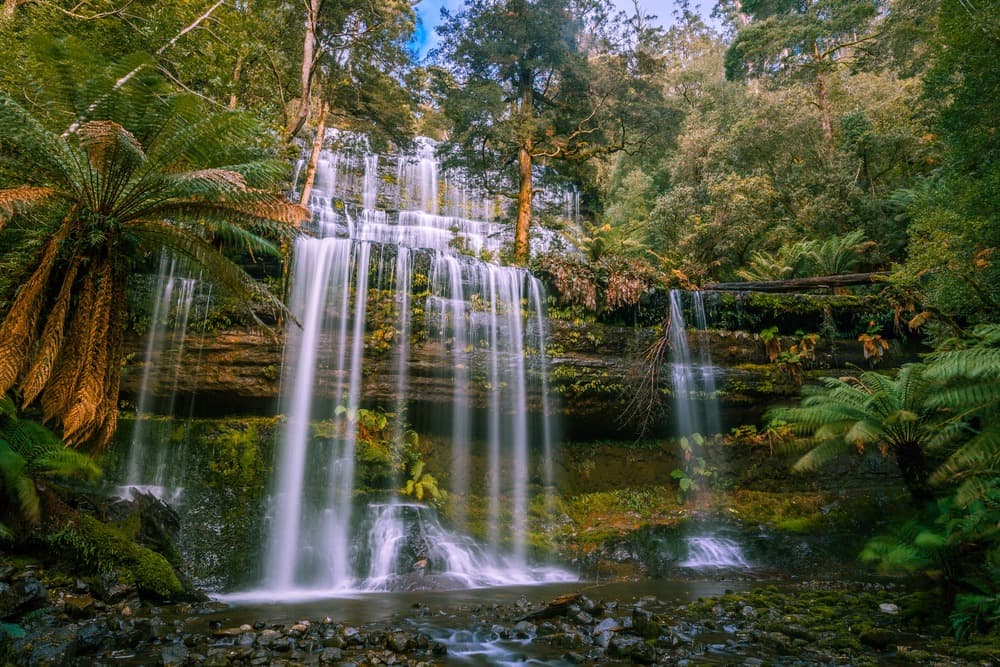
In the heart of Tasmania, within Mount Field National Park, Russell Falls offers a first glimpse into the Australian wilderness. Among the towering trunks of temperate rainforest, the cascade reveals itself in a fresh and serene setting, marked by the steady rhythm of falling water.
A symbol of the island's untamed beauty, it has long attracted travellers and photographers. It's an ideal introduction before exploring the landscapes and forests of Mount Field.
Discovered in 1856, the falls were initially named Browning Falls, in honour of their discoverer. Renamed Russell Falls in 1884, they were already among the natural attractions noted by early visitors.
In 1885, the site was officially protected for its natural value, becoming one of Tasmania's first reserves. This recognition played an essential role in preserving the island's natural heritage. In 1916, the reserve was incorporated into Mount Field National Park, the first national park declared in the state.
In 1899, the falls were also featured on a series of illustrated stamps, testament to their growing renown and importance in promoting the region.
Listed within the Tasmanian Wilderness World Heritage Area, Russell Falls now ranks among the island's iconic natural sites. Located approximately 70 kilometres north-west of Hobart, in the eastern section of Mount Field National Park, near Horseshoe Falls.
A paved track winds through the temperate rainforest, leading to several viewpoints of the cascade. Water descends in two tiers into a pool bordered by tree ferns and giant eucalyptus. Marine siltstone and sandstone formations echo the site's ancient geological origins.
Russell Falls remains today a place where natural history, tranquillity and preserved nature converge.
A short walk from the visitor centre, a paved track winds through the rainforest and offers several vantage points of the cascade. Dense vegetation, composed of tree ferns, moss and giant eucalyptus, creates a cool and shaded atmosphere.
- Follow the paved track to the cascade: a short and accessible walk to admire the falls from different angles.
- Wander through the rainforest: the path traverses vegetation typical of Mount Field, rich with lush understory.
- Observe wildlife in the late afternoon: pademelons and possums are sometimes spotted along the track.
- Enjoy the picnic areas: several shaded zones allow for a rest near the park entrance.
Beyond the falls, Mount Field National Park offers a wide variety of landscapes, from ancient forests to alpine terrain.
- Discover the alpine plateau of Mount Field: climbing to higher elevations, the forest gives way to open vistas and alpine vegetation.
- Marvel at the giant trees of Styx Big Tree Reserve: a timber boardwalk winds between some of the world's tallest trees.
- Enjoy seasonal activities: alpine skiing and cross-country skiing in winter; fly fishing or caving depending on the season.
- Explore other park tracks: several routes lead to wetlands, mountain lakes or dense forests.
Russell Falls is a little over an hour's drive from Hobart. Follow the A10 towards New Norfolk, then continue to Westerway via the B62. A short winding stretch then leads to the village of National Park, where the park entrance and visitor centre are located.
From the car park, a paved track of about twenty minutes leads directly to the falls. A TasMap of the area is available at the visitor centre.
It is advisable to avoid driving at night: wildlife is very active and many animals cross roads after dusk.
Give it a go!
Our local experts arrange this activity for you.