Top End & Kakadu
The tropical north around Darwin, where Kakadu National Park, Arnhem Land and Litchfield are explored by 4x4 between May and October, with Aboriginal guides.
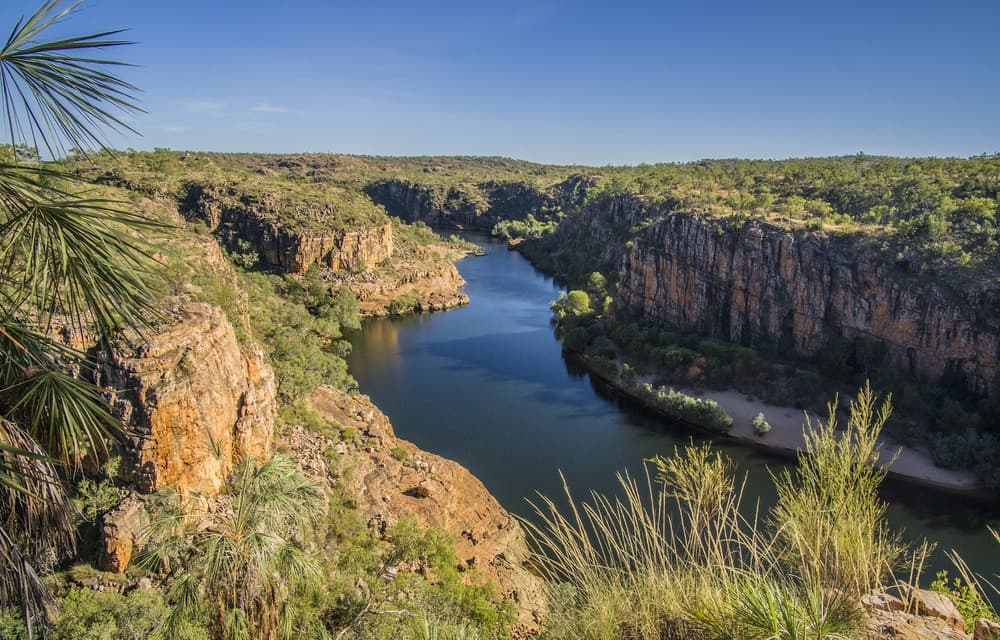
The Top End refers to the tropical tip of the Northern Territory, centred around Darwin, the regional capital and the only substantial city within 1,000 kilometres in any direction. It is a region of eucalyptus-dotted savanna, cathedral-like termite mounds rising several metres high, rivers lined with mangroves, and sandstone escarpments marking the transition between the flood plains and the Arnhem Plateau. We work there year-round, but we only send our travellers during the dry season, from May to October, when 4x4 tracks are passable and sites are accessible.
Kakadu National Park, inscribed on the World Heritage list for both its natural and cultural values, covers nearly 20,000 km², about half the size of Belgium. It is co-managed by the traditional owners, the Bininj and Mungguy people, who still live there. The rock paintings at Ubirr and Burrunggui (Nourlangie) depict mythological sequences and hunting scenes, some dating back more than 20,000 years, while others are much more recent, featuring European boats. A visit to these galleries truly comes alive with a local Aboriginal guide, who explains the role of the Rainbow Serpent and the ritual function of each figure.
East of Kakadu lies Arnhem Land, a restricted Aboriginal territory that can only be visited with a permit and an approved operator. We organise day excursions to Injalak Hill, near the Gunbalanya community, where an art centre brings together Kunwinjku painters and weavers. It is one of the rare contexts where travellers meet artists directly and discuss works in progress. The track crosses the East Alligator River at low tide, which is only possible at certain times, and our drivers adjust the schedule accordingly.
Further west, Litchfield Park offers a more accessible experience: its waterfalls—Florence Falls, Wangi Falls and Buley Rockhole—are safe for swimming as saltwater crocodiles do not venture upstream. This is our solution for families or travellers wanting a taste of tropical nature without committing to the long tracks in Kakadu. Allow two hours' drive from Darwin, compared to three hours to reach the first Kakadu entrance at Jabiru.
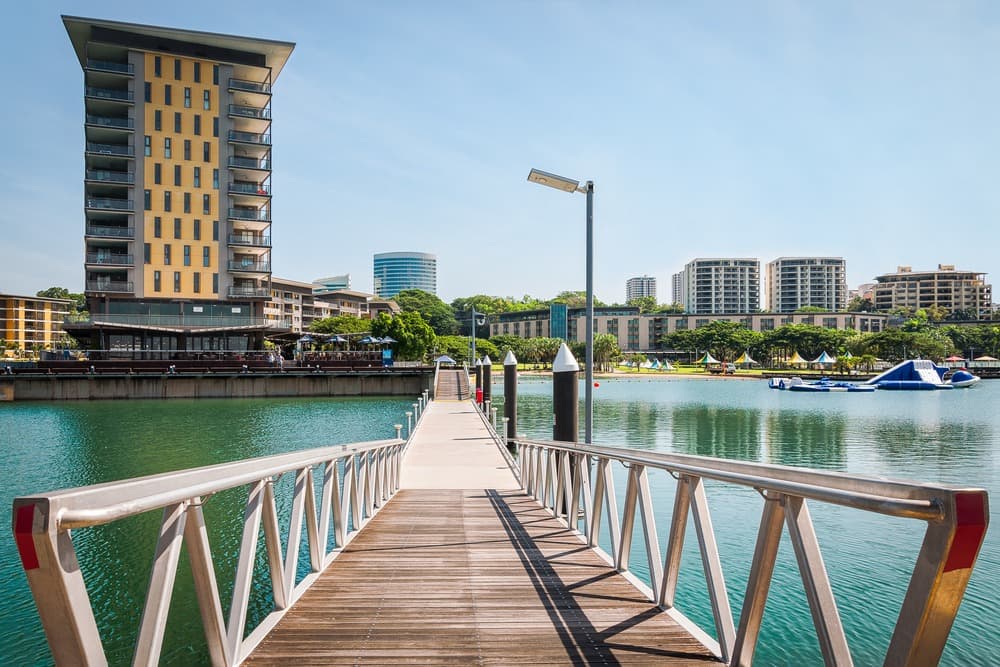
Darwin itself deserves a day or two. The city was destroyed by Japanese bombing in 1942 and then by Cyclone Tracy in 1974, which explains its modern architecture and relaxed outdoor culture. The Mindil Night Market, open on Thursdays and Sundays during the dry season, brings together Asian cuisines inherited from Timorese, Malay, Greek and Indonesian communities settled here since the 19th century. You can eat barramundi curry laksa, buffalo satay and seasonal mangoes. Darwin is also where the logistics of the journey are arranged: hiring elevated 4x4s, briefings on tides and track conditions.
The fauna of the Top End remains among the most visible in Australia. Saltwater crocodiles, commonly exceeding four metres in length, can be observed from morning cruises on Yellow Water at Cooinda or on the Adelaide River. The flood plains host remarkable concentrations of water birds early in the dry season—magpie geese, jabirus, dendrocygnas—around the shrinking water holes. At sunset from the Ubirr lookout, you take in a single sweep the river, grassy plains, sandstone escarpment and the distant dark line of monsoon forest: this is the moment when you truly understand Kakadu's geography.
Highlights
Morning cruise on Yellow Water. Departing from Cooinda, two hours on the billabongs at sunrise, with saltwater crocodiles along the banks, jabirus and giant water lilies in the mist that gradually clears.
Rock art sites at Ubirr and Burrunggui. Painted galleries sheltered beneath sandstone overhangs, narrated by a Bininj guide, followed by the climb to Ubirr lookout for sunset views across the flood plains.
Arnhem Land excursion. Crossing the East Alligator River at low tide to reach Injalak Hill and its art centre at Gunbalanya, by permit and with an approved operator only.
Swimming at Litchfield waterfalls. Florence Falls and Buley Rockhole, two pools of clear water set among boulders and monsoon forest, crocodile-free, two hours' drive from Darwin.
Jim Jim and Twin Falls in the dry season. Demanding 4x4 track from Kakadu Highway, then a short walk through a sandstone canyon to pools set beneath 150-metre cliffs.
When to Go
The Top End experiences two distinct seasons and we only operate during one of them. The dry season runs from May to October: clear skies, humidity dropping to around 40 to 60 per cent, daytime temperatures of 30 to 33 °C and nights falling to 17 to 20 °C in June and July, the most comfortable months. This is the window when tracks to Jim Jim, Twin Falls and Maguk are open, usually from late May or early June depending on residual flooding. September and October, locally called the build-up, become hotter and more humid, reaching 35 °C with rising humidity, but water holes contract and wildlife becomes more visible.
The wet season, from November to April, receives over 1,500 mm of rainfall, mainly in late afternoon storms. Roads to the main falls are closed, crocodile cruises operate at reduced capacity and sticky heat discourages walking. Some travellers come during this period to photograph storms from Darwin and falls at full flow seen by helicopter, but this is not a ground-based discovery trip, and we advise against it for a first visit.
Practical Information
We recommend six to seven days in the region to do it justice: two nights in Darwin and Litchfield, three to four nights in Kakadu split between Jabiru and Cooinda, and one day in Arnhem Land if the permit is granted. Distances look modest on the map but secondary tracks are travelled at 40 km/h, and several major sites require a one to two-hour walk-in. Darwin Airport, served by direct flights from Singapore, Bali and major Australian cities, is the only logical entry point. Our travellers collect an elevated 4x4 there, essential for Jim Jim and Twin Falls.
The Top End combines naturally with the Red Centre via the Darwin-Alice Springs flight, allowing you to experience two Northern Territory landscapes in two weeks. Connection to Western Australia via the Gibb River Road is possible but requires an additional ten days by 4x4. Accommodation is decent without being luxurious: lodges bordering the park, motels in Jabiru, a few good-quality safari camps at Cooinda and Bamurru Plains. This region suits travellers curious about Aboriginal cultures, wildlife enthusiasts and hikers accustomed to heat. It is less suitable for very young children due to temperatures and distances.