Western Australia
Western Australia stretches across 2,400 km between the coral reefs of Ningaloo, the red gorges of Karijini and the remote tracks of Kimberley, far from the beaten path.
Western Australia spans a third of the continent by itself—2.5 million km² with 2.8 million inhabitants concentrated 80% around Perth. From our local agency, we guide travelers through a state where traversing north to south, from Perth to Broome, requires a minimum of three weeks to absorb the 2,400 km of coastline and inland detours. Here, you drive long distances between points of interest, and it's precisely this breathing room that gives the journey its value.
In the south, the climate is Mediterranean: dry summers around 30°C, mild and rainy winters. The Margaret River region, three hours' drive from Perth, concentrates 200 wine estates producing mainly cabernet and chardonnay, forests of karri (giant eucalyptus trees reaching up to 90 meters) and recognized surf spots like Surfers Point. The villages of Dunsborough, Yallingup and Augusta structure this coastline where the Indian Ocean meets the Southern Ocean at Cape Leeuwin. Further east, the southern coast around Esperance and Cape Le Grand National Park offers white sand beaches bordered by turquoise waters, populated by kangaroos that come down to the shore.
Moving north, the landscape changes dramatically. The Pinnacles Desert, in Nambung National Park, lines thousands of limestone columns 1 to 4 meters high across ochre sand. Shark Bay, a UNESCO World Heritage site, is home to Monkey Mia where a population of bottlenose dolphins habituated to human contact since the 1960s resides, and to Hamelin Pool where stromatolites—living bacterial structures among Earth's oldest known life forms—thrive. Further north, Coral Bay and Exmouth provide access to the Ningaloo coral reef, 260 km long, where whale sharks come to feed on plankton from March to July and manta rays are visible year-round.
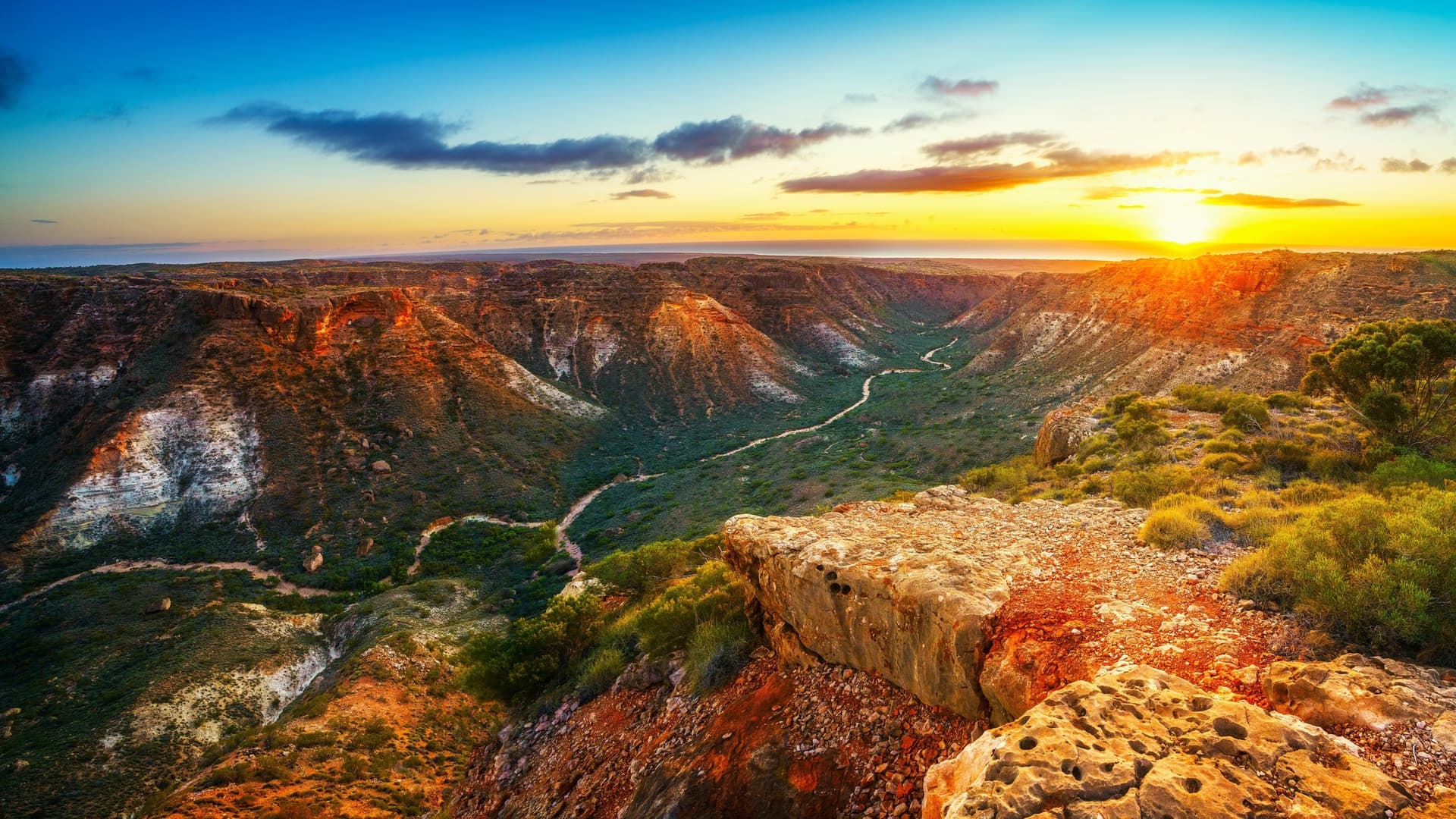
The interior Pilbara, 1,500 km north of Perth, is home to Karijini National Park: narrow gorges carved into red rock 2.5 billion years old, punctuated by waterfalls and natural pools like Fern Pool, Fortescue Falls and Hancock Gorge. It's also the heart of Australia's mining industry, where iron ore trains—among the world's longest—cross the desert to the ports of Dampier and Port Hedland. This industrial dimension is part of the landscape and explains why certain outback settlements boast unexpected logistics.
Beyond the Tropic of Capricorn, Kimberley sets a different pace. Broome, once the world's pearl diving capital, preserves a historic Japanese and Chinese quarter (Chinatown), and Cable Beach stretches for 22 km. The Gibb River Road, a 660 km track crossing Kimberley east to west, links gorges (Bell Gorge, Manning Gorge), cattle stations and Aboriginal rock art sites Wandjina and Gwion Gwion, among the world's oldest. The Yawuru people around Broome, the Bunuba in central Kimberley, the Martu in the western desert maintain strong ties to their lands, and some communities welcome guided visits.
On the culinary side, Western Australia's food scene draws on seafood (marron, Geraldton crayfish, Albany oysters), southwest wines, and bush ingredients like Kakadu plum or bunya nut. In Perth, Fremantle Market on weekends and the microbreweries of Northbridge give a glimpse of the local scene.
Must-see
Ningaloo Reef at Exmouth. Swim with whale sharks from March to July and manta rays year-round, just meters from shore near Coral Bay. A reef accessible directly from the beach, without the tourist pressure of the Great Barrier Reef.
Karijini Gorges. Four days' hiking through red Pilbara canyons, with descents into Hancock Gorge and swims in Fern Pool. Nights are spent at Eco Retreat campground, 1,600 km from Perth.
Gibb River Road in Kimberley. 660 km of 4x4 track between Derby and Kununurra, punctuated by gorges (Bell, Manning, El Questro) and century-old cattle stations. Accessible only May to September, after the monsoon rains subside.
Margaret River and the southwest. Tastings at estates like Vasse Felix or Cullen, walks through karri forests of Boranup Park, and humpback whale watching at Cape Naturaliste between September and December.
Hamelin Pool Stromatolites. Wooden boardwalk above living bacterial structures, direct witnesses to Earth's earliest life forms 3.5 billion years ago. A rare site globally alongside the Bahamas.
When to Visit
The broadest window for traveling throughout the state spans April to October. In the north (Broome, Kimberley, Ningaloo), it's the dry season: days between 28 and 32°C, clear skies, open tracks. November to March, the monsoon makes the Gibb River Road impassable, temperatures regularly exceed 38°C in Broome and humidity approaches 80%, with real cyclone risk between December and April.
In the south (Perth, Margaret River, Esperance), the schedule partly reverses: the Australian summer of December to February is dry and hot (28 to 35°C in Perth), ideal for the southern coast, while winter June to August brings rain and daytime temperatures around 17°C. To combine south and north on the same trip, May-June and September-October offer the best compromise: Ningaloo accessible with whale sharks, Karijini without excessive heat, and the southwest still manageable.
Practical Tips
Three weeks is a realistic minimum to drive Perth-Broome while covering Pinnacles, Shark Bay, Ningaloo, Karijini and the Broome region. To also include Margaret River and the southern coast, allow four weeks. Domestic flights Perth-Broome (2h30) or Perth-Exmouth let you shorten the drive if time is tight, and we regularly organize 12 to 14-day itineraries focused on a single section. Entry is via Perth Airport, well connected to Singapore, Dubai and Southeast Asia.
Western Australia logically combines with the Top End & Kakadu (Broome-Darwin flight 2h) to extend the tropical experience, or with the Red Centre to shift toward Uluru from Perth via Alice Springs. Combining with the East Coast & Sydney involves at least 5 hours of flying and changes the atmosphere entirely—reserve this for five-week minimum stays. Accommodation ranges from bush lodges to serviced camping to urban hotels in Perth and Broome. The region suits autonomous travelers who enjoy driving (long distances, safe roads), nature and snorkeling enthusiasts, and families with teenagers. Less suited to short stays or travelers seeking dense urban cultural experiences.