Spotlight on the Kangaroo, Australia's Iconic Animal
It is the emblematic animal of the country that every traveler encounters at least once during a trip to Australie. But do you really know the particularities and lifestyle of this marsupial?
It is the emblematic animal of the country that every traveler encounters at least once during a trip to Australie. But do you really know the particularities and lifestyle of this marsupial? We'll paint you a portrait of the largest of the macropods and share all our expert tips for spotting kangaroos in ideal conditions during your stay in Australie.
Portrait of the Kangaroo: Description, Lifestyle...
The kangaroo is a marsupial (meaning a viviparous mammal whose embryonic development is completed in the ventral pouch of the mother, called marsupium or marsupial pouch) of the macropod family ("macro" meaning "large" and "pod" meaning "foot" in Latin). The kangaroos we know today are believed to be descendants of the wynyardia, a marsupial native to Tasmania that appeared 25 million years ago and is now extinct.
Did you know? Do you know why the kangaroo is called by that name? The word kangaroo originates from the Guugu Yimithirr, an Aboriginal tribe from far northern Queensland in Australie. As explained by Australie's tourism office: "The term 'kangaroo' comes from the word 'gangurru,' which is the name given to giant kangaroos by the Guugu Yimithirr people of tropical northern Queensland." |
How many species of kangaroo are there?
There are around fifty species of macropods divided into several groups (including kangaroos, tree kangaroos and wallabies). Kangaroos are considered the largest species of macropods while wallabies are the smallest.
Strictly speaking, kangaroos are classified into four subspecies:
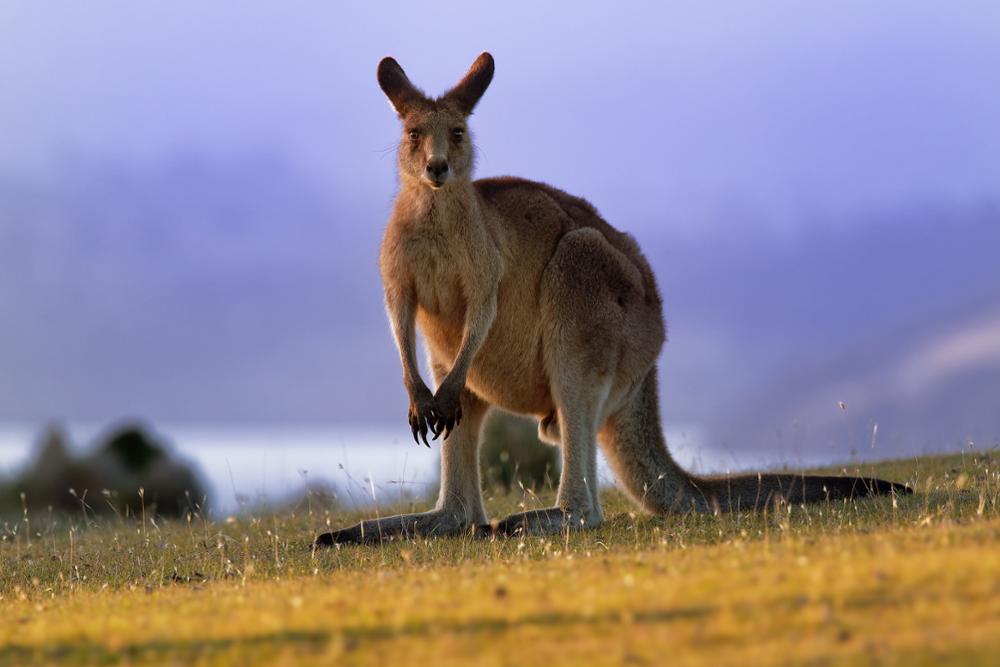
The eastern grey kangaroo (Macropus giganteus): recognizable by its grey fur and white belly, the kangaroo is not, despite its name, the largest of all kangaroo species;
The red kangaroo (Macropus rufus): reaching up to 1.80 m and weighing up to 90 kg, the red kangaroo is the most imposing of all. It owes its name to the color of its fur;
The western grey kangaroo (Macropus fuliginosus): often confused with the eastern grey kangaroo due to their similar coloring, the western grey kangaroo has fur that varies from grey to chocolate. Females are twice smaller than males;
The antilopine kangaroo (Macropus antilopinus): measuring 1.20 m and weighing 37 kg, it is the smallest of the four. Males are reddish while females are grey.
What are the differences between a kangaroo and a wallaby? Kangaroos and wallabies are both species belonging to the macropod family. What sets them apart? Their size and weight, as well as their lifestyle. Indeed, wallabies are smaller than kangaroos and have thinner legs. There are also wallaroos, the common name given to several species of medium-sized macropods, intermediate between kangaroos and wallabies. |
How high can kangaroos jump?
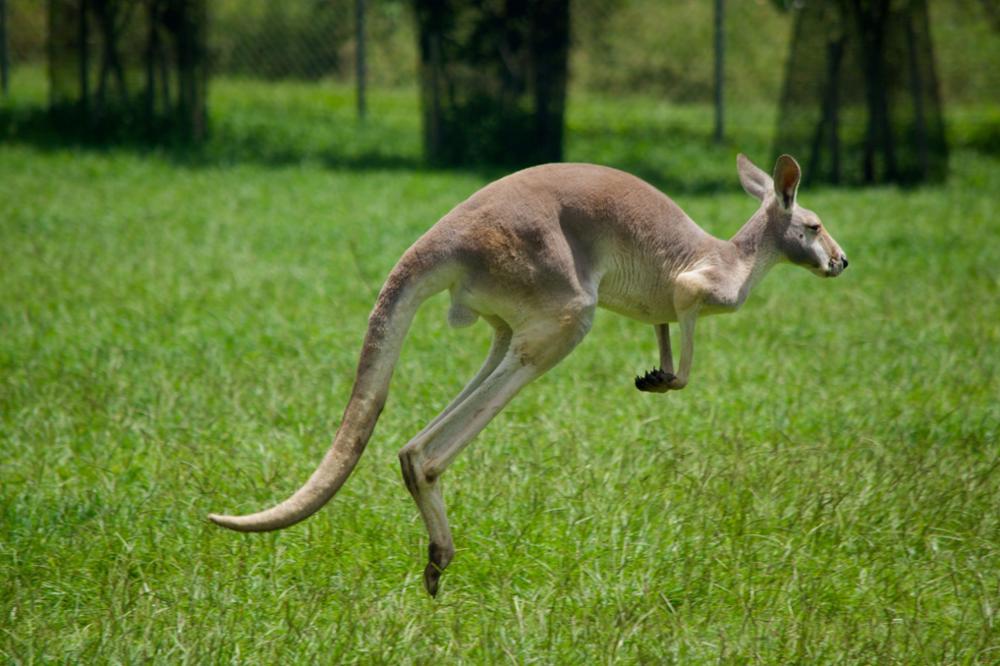
The kangaroo is characterized by large hind limbs (hence the name of their family) and an ultra-powerful tail. These features enable it to move about. Indeed, the kangaroo moves by making bounds. To do this, it uses its hind legs like springs to propel itself and uses its muscular tail as a counterbalance. Note that at rest, the kangaroo uses its tail as a tripod to stabilize itself.
Given this singular morphology, the kangaroo is capable of performing spectacular jumps of up to 9 meters long and 3.30 meters high, although normally it makes leaps of around 2 meters on average.
As for its speed, the kangaroo can reach 60 to 80 km/h at top speed, particularly when it feels threatened and is forced to flee. The rest of the time, its cruising speed hovers around 20 to 30 km/h.
What does the kangaroo eat?
The kangaroo follows a herbivorous diet: it feeds on grass, leaves, tree shoots and fruits. Some species are also insectivorous and consume insects in addition to vegetation. It eats mainly at dawn and dusk, when temperatures are cooler. Renowned for its excellent ability to adapt to arid environments, the kangaroo drinks very little water and can even go without drinking for several days.
How does the kangaroo reproduce?
The reproduction of kangaroos is unique in the animal kingdom. After a very short gestation period (30 to 38 days depending on the species), the young is born at an early stage (2 cm – 0.8g). It leaves the uterus to climb into the mother's pouch, where it can continue to develop and feed by clinging to one of its mother's 4 teats. It remains in the marsupial pouch for approximately 250 days, or roughly 9 months, before leaving it permanently and being fully weaned at around one year of age.
The reproductive mode of kangaroos is unique because of the presence of a marsupial pouch. But that's not all! Indeed, the mother kangaroo has the peculiarity of being able to have up to 3 babies simultaneously. But how is this possible?
One or two days after the birth of a baby, the mother mates again. The embryo resulting from this mating is then put "on hold": this is called embryonic diapause. The development of the fetus is then stopped until the baby already born leaves the pouch. Furthermore, females often have 3 babies in their care: an embryo waiting, a baby developing in the pouch and a baby outside the pouch.
Pausing the development of the embryo is a strategy that the animal can also use in case of food shortages and drought.
Good to know: A female kangaroo is called a "Flyer," a male kangaroo is called a "Boomer" and a baby kangaroo is called a "Joey." |
What is the lifestyle of kangaroos?
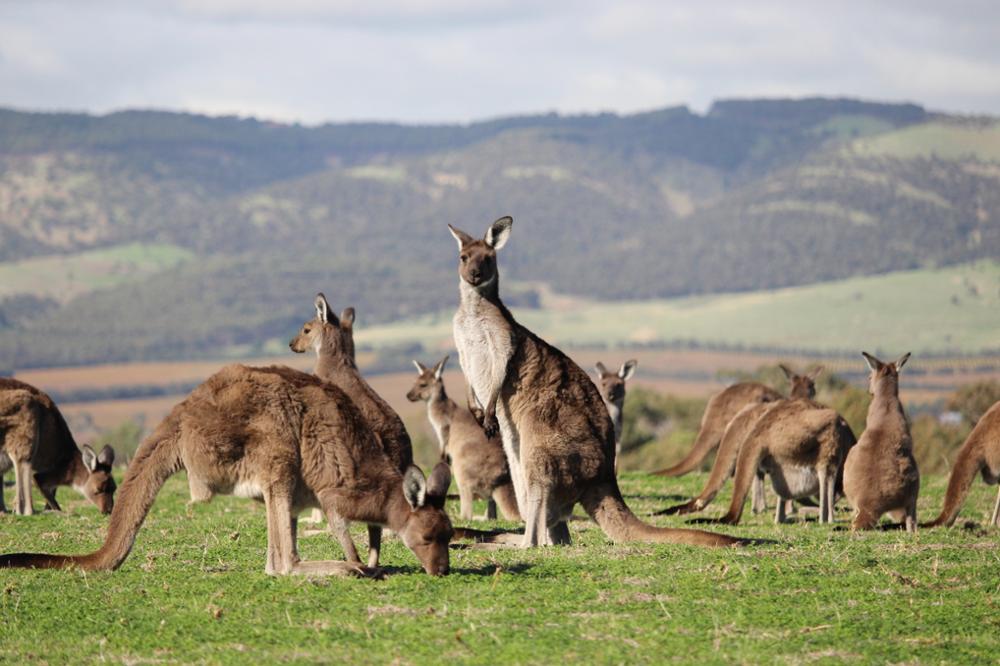
Kangaroos live in small groups (called mobs) of around ten individuals generally made up of a dominant male, females and their young. It also happens that young kangaroos form small emancipated groups. These are sedentary animals that, contrary to popular belief, do not undertake long journeys and prefer to stay within a small territory.
Kangaroos are essentially crepuscular or nocturnal: they are active at dawn and dusk and prefer to rest in the shade during the day. They have the habit of licking the skin of their forearms to cool down. And for good reason, the evaporation of saliva helps dissipate heat from blood vessels.
What are the kangaroo's predators?
Kangaroos don't really have predators other than dingoes and wild dogs, which primarily attack the smaller species, the youngest, the elderly and sick specimens.
To face dingoes, kangaroos have adopted a devastatingly effective strategy: they lead them to a water point to try to drown them. It should be known that the kangaroo cannot walk, but can swim perfectly. Another defensive tactic: delivering powerful kicks that can be lethal given their force.
It should also be noted that certain birds of prey (notably sea eagles and Australie's eagles) can also attack kangaroos, as can certain snake species. Finally, man can be considered a predator of the kangaroo since the latter kills thousands of them each year for their meat, skin and in order to regulate populations.
What is the kangaroo's life expectancy?
Kangaroos can live up to 20 to 25 years in captivity compared to only 6 to 15 years in the wild.
Spotting Kangaroos in Australie: Our Practical Guide
Why is the kangaroo a symbol of Australie?
In Australie, the kangaroo has always been a symbol, and has been so for thousands of years: it appears in numerous rock carvings, is the subject of numerous myths and stories. This animal endemic to Australie is even used, alongside the emu, to appear on the country's official emblem. Why? Because it symbolizes a nation that is always moving forward. And for good reason, because of its particular morphology, the kangaroo cannot move backward or jump backward and thus represents progress!
Where to see kangaroos in the wild in Australie?
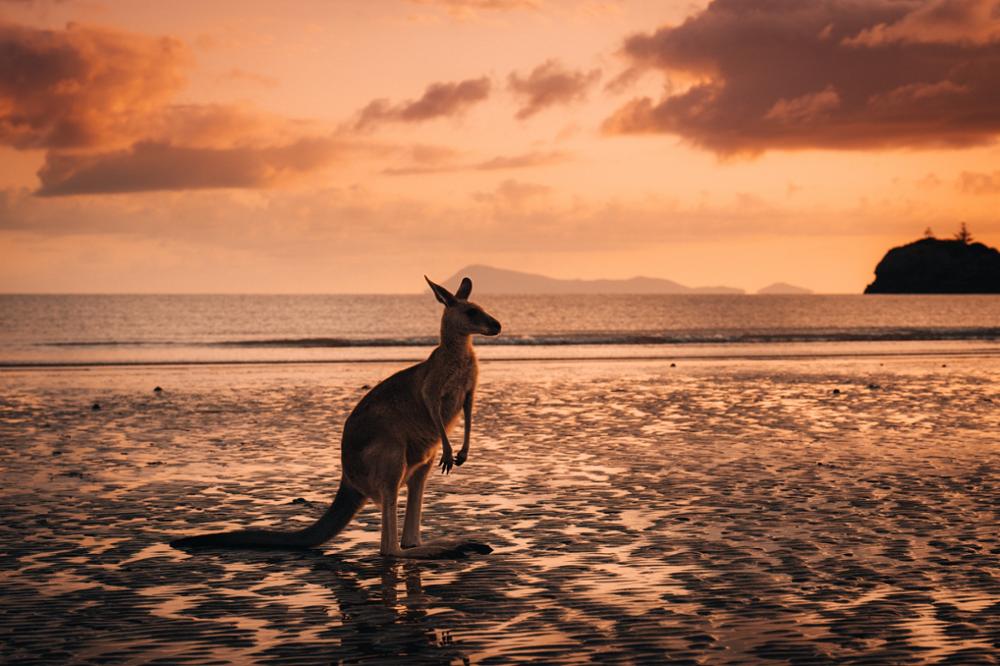
You can see kangaroos in the wild in all regions of Australie, both in plains and countryside as well as on beaches or in national parks.
Here are the best places to see wild kangaroos in Australie according to the different states of the country:
Namadgi National Park (New South Wales),
Kosciuszko National Park (New South Wales),
Pebbly Beach in Murramarang National Park (New South Wales),
Jervis Bay (New South Wales),
Tidbinbilla Nature Reserve (New South Wales),
Woodlands Historic Park (Victoria),
Wilsons Promontory National Park (Victoria),
Grampians National Park (Victoria),
Phillip Island Nature Park (Victoria),
Along the Great Ocean Road (Victoria),
Freycinet National Park (Tasmania),
Maria Island (Tasmania),
Kangaroo Island (South Australie),
Gawler Ranges National Park (South Australie),
Flinders Ranges (South Australie),
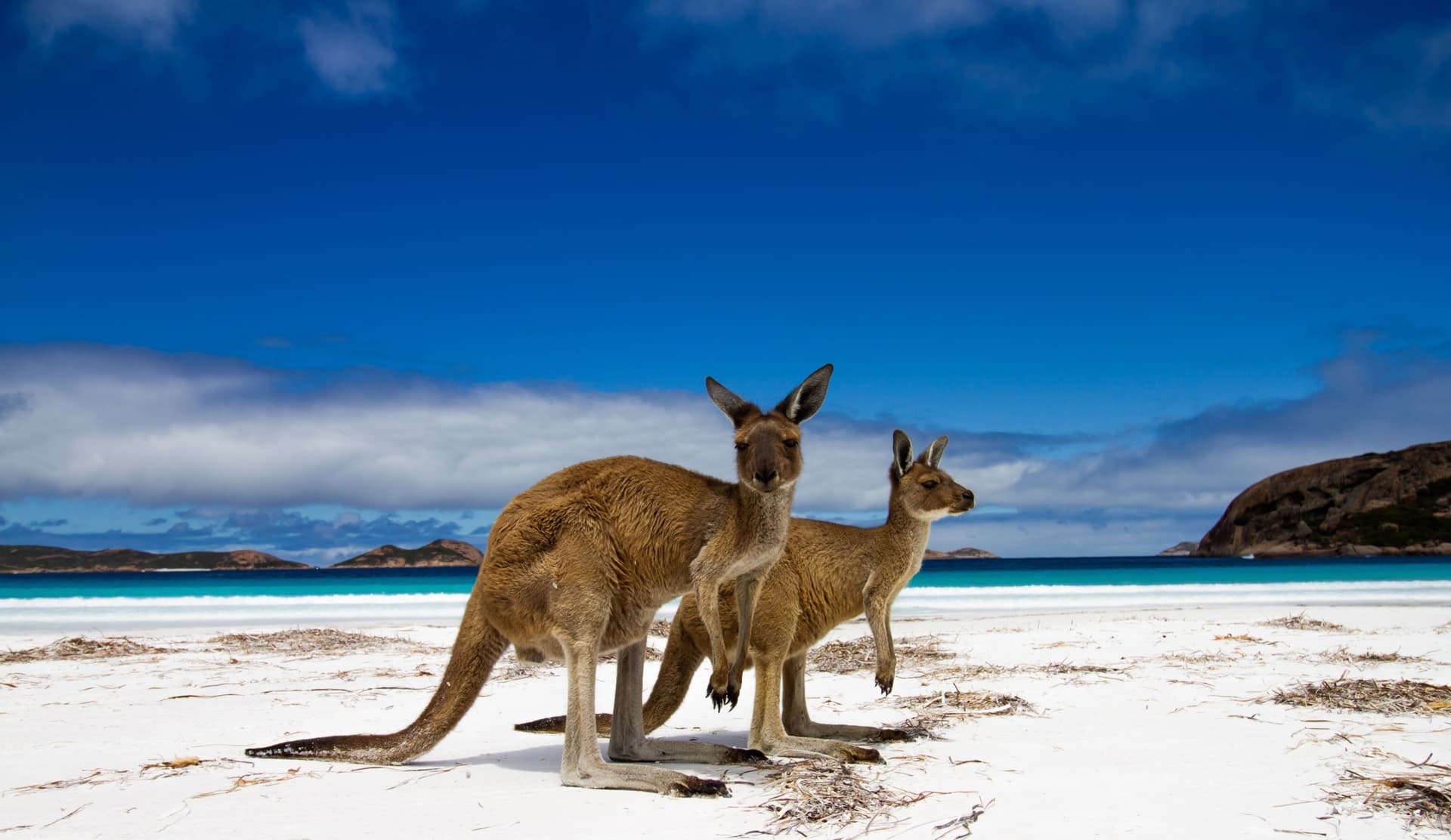
Lucky Bay, one of the most beautiful beaches in Australie located in Cape Le Grand National Park (Western Australie),
Yanchep National Park (Western Australie),
Cape Hillsborough Natural Coastal Estate (Queensland),
Bunya Mountains National Park (Queensland),
Magnetic Island (Queensland),
Girraween National Park (Queensland),
Noosa National Park (Queensland),
The rural area around Alice Springs (Outback)...
To remember: As mentioned previously, kangaroos are more active in early morning or late afternoon when temperatures are cooler. For this reason, the best time to try to see kangaroos is either at dawn or at dusk. |
Is the kangaroo dangerous to humans?
Kangaroos are relatively peaceful animals that very rarely attack humans. Indeed, they are quite shy and are not as easy to approach as their cousin, the wallaby. That said, they can adopt aggressive behavior if they feel threatened. As you've understood, although kangaroos may seem cute at first glance, they remain unpredictable wild animals that are best kept at a distance rather than approached.
As a reminder, kangaroos are excellent boxers and can inflict real injuries by kicking or using their sharp claws. That said, only two fatal attacks have been reported throughout the country in nearly a century.
How to behave around a kangaroo?
Is it safe to pass by a kangaroo? Can you pet a kangaroo or feed it? If you're asking all these questions, then you'll want to read the following lines.
Rules of conduct for seeing kangaroos safely in Australie:
Keep safe distances in company: if you spot kangaroos, observe them from a distance so as not to disturb them or attract their attention. Generally, they will be afraid of you and won't come near you. Not touching them also helps prevent the transmission of disease;
Never feed kangaroos: this can make them aggressive toward humans and harm their natural behavior;
Never take unnecessary risks to approach a kangaroo: you've spotted kangaroos but they seem agitated? You've just witnessed a fight between two males or a mating scene? You've seen babies in the company of parents? In all these situations, one rule applies: keep your distance and move away to avoid any incident;
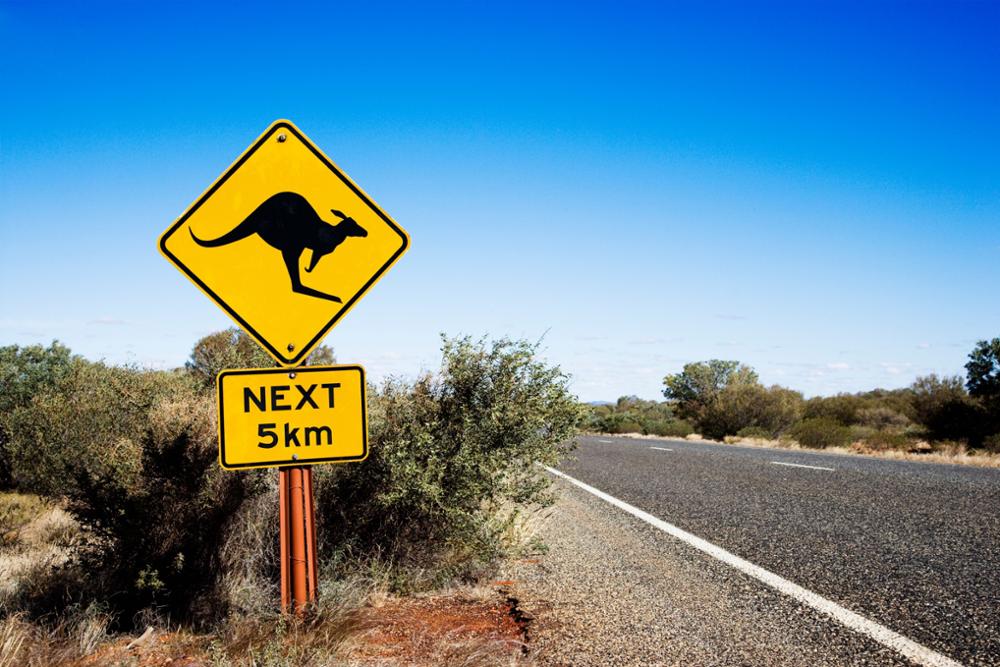
Be vigilant on roads: kangaroos can appear out of nowhere in Australie. Remember to drive slowly and watch the roadsides, particularly at dawn and dusk, to avoid any accidents;
Always keep your dog on a leash: if you're traveling with a pet, make sure to keep it on a leash to avoid any interaction with kangaroos, which view them as potential enemies.
What to do in case of attack or aggressive behavior from a kangaroo?
Although it's difficult to control your reactions in such a situation, it is recommended never to run away when a kangaroo shows signs of aggression (approaching, growling, tail striking...). This will only give it one desire: to chase you! In the same way, you must not provoke it by making abrupt gestures.
As explained by New South Wales' National Parks and Wildlife Service: "If it continues to approach, crouch down and stay near the ground, covering your face and neck with your hands, then position yourself behind a shrub or other shelter."
As you've understood, the best thing to do is to submit completely, make yourself small and protect yourself by curling up into a ball, in the same way a kangaroo dominated by a dominant male would. By remaining calm and still, there's a good chance the animal will stop its confrontation and go away peacefully.
And remember: attacks are infrequent, so there's no need to worry every time you see one. The key is to adopt responsible behavior and follow local guidelines.
Need help organizing your trip to Australie? Don't hesitate to contact us to benefit from our expert advice and create an itinerary (guided or self-guided) tailored to your desires and budget!